
By Muhammed Bello Buhari | April 30, 2024
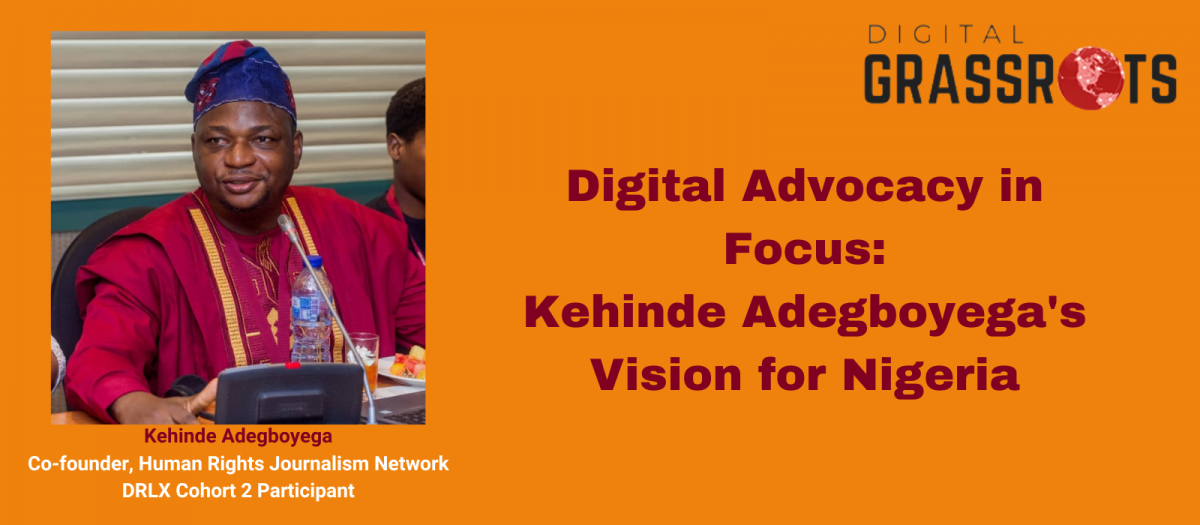
In our latest discussion, we sat down with our community member and DRLX alumnus, Kehinde Adegboyega to delve into his hands-on work with the Human Rights Journalist Network in Nigeria. Kehinde discussed the intricate balance of promoting digital rights, confronting the rising tide of misinformation, and navigating government regulations in the digital domain. Through collaborations with global organisations like Access Now and local initiatives addressing fake news during elections, Kehinde is actively shaping a safer digital environment in Nigeria.
DIGRA: We wanted to provide a space to discuss your work and the activities you have been involved in since joining the program. We would like to begin our conversation by asking you to talk about your professional journey and how you came to co-found the Human Rights Journalist Network Nigeria.
Kehinde: Certainly. My name is Kehinde Adegboyega. We co-founded the network to address the gap we identified in sustainable reporting of human rights issues. We noticed that issues, especially pressing ones like police brutality, can quickly be forgotten due to the fast pace of news and various topics brought up in social media. To address this, we initiated collaborations with human rights organisations, such as Amnesty International in Nigeria, to empower journalists to understand and report on various critical issues more effectively. We started primarily with virtual sessions, and recently we have begun hosting physical events. For instance, last year we organised a remote hub for the Internet Governance Forum and launched the Africa International Human Rights Film Festival to use film as a medium to advocate for pertinent issues in Nigeria.
DIGRA: That is very insightful, especially considering that you started in 2019, shortly before the pandemic which moved many activities online. Could you tell us about the projects and initiatives you have been spearheading recently, perhaps those connected to the digital rights space?
Kehinde: Certainly. In 2022 we initiated sessions on digital rights, starting with Digital Rights and Inclusion Forum by Paradigm Initiative on internet shutdowns. We also hosted a training on digital security for journalists, in collaboration with organisations like Access Now and a PAN organisation in Nigeria. In 2023, we continued with sessions at various international conferences, discussing the challenges of fact-checking in the digital age, especially in the context of elections, and examining the impact of authoritarian laws on freedom of expression in Nigeria. Our work has expanded to embrace the digital space more fully, given the increasing move of media to online platforms. This transition has been met with stringent regulations from the Nigerian government, affecting even what broadcast media can publish on their social media platforms. We have also seen other agencies, such as the Advertising Regulation Council of Nigeria, imposing policies to regulate the digital space which traditionally focused on mainstream advertising.
There is a growing concern over these developments, especially with reports of the Nigerian government acquiring potent spyware. This has underscored the urgency to scrutinise how the government is regulating the digital space and advocate for the protection of digital rights. During recent elections, we observed an increase in fake news and online attacks orchestrated by government officials and non-state actors connected to the government. These officials would create groups directing individuals to attack anyone speaking out against leading politicians. We saw online threats materialise offline, with intimidation and tribal profiling used to discourage people from voting. There were even instances of violence at polling units, all stemming from the threats and hate speech propagated online. The threats voiced online did not stay there; they translated into real-world harm during the elections. Despite the dangerous environment, we are working to empower journalists and citizens to analyse policies critically and hold the government accountable to international human rights standards. Many policies are introduced under the guise of being for the public’s good like national security, but we aim to help people understand the deeper implications these policies might have on their lives. Our goal is to foster a better democracy and government by educating individuals on the pressing issues in the digital space, emphasising that the repercussions are far-reaching and affect everyone.
DIGRA: It seems like you have a rich background of collaborations and learning experiences in the digital rights sphere. Could you share more about the training and programs you have been a part of?
Kehinde: Absolutely. A significant aspect of our growth has been through fellowships, including the Digital Rights Learning Exchange Program. I have also enriched my understanding through other platforms like the Nigerian School of Internet Governance and the West African School of Internet Governance, both in 2021 and the African School on Internet Governance and the Advocacy Assembly’s Internet Shutdown Fellowship in 2023. I first delved into the digital rights space through a Paradigm Initiative, a pan-African NGO that initiated a digital rights academy, hosting various stakeholders for workshops on digital rights issues and litigation strategies. Moreover, I participated in a virtual course on digital rights in Africa at the Centre for Human Rights, University of Pretoria. These experiences, coupled with the Digital Rights Learning Exchange Program, have not only broadened my horizon but emphasised the pressing issues in the media sector, which is currently facing heightened oppression in the digital space. It is imperative now, more than ever, to focus on this area as most media outlets have transitioned online, a move followed by the imposition of numerous restrictive policies by the Nigerian government.
For instance, the National Broadcasting Code, initially designed to regulate terrestrial broadcasting, has now broadened its scope to monitor what broadcast media share on their social media platforms. Additionally, agencies like the Advertising Regulation Council of Nigeria are formulating policies aimed at the digital realm, even though their original focus was solely mainstream advertising. It’s evident that every government agency is eager to wield some level of control in this domain. What’s alarming is that some of these agencies have sidestepped the need for parliamentary consent when introducing new regulations. Acknowledging this, it becomes crucial for us to examine the strategies the Nigerian government employs in the digital sphere. This is even more significant considering revelations from Access Now about the government’s procurement of sophisticated surveillance tools like the Pegasus Spyware. The Nigerian government justified the acquisition of such technologies by asserting they were necessary for monitoring terrorist activities, especially in the northern regions. But, in reality, these tools have been leveraged to spy on journalists, ordinary citizens, and activists. Their misuse became even more pronounced during the 2020 ENDSARS protests. Activists found themselves tracked to their residences and workplaces. Photojournalists, who were merely documenting events, faced dire consequences, with some even forced to leave the country for their safety. However, we remain undeterred. We’re actively partnering with organisations both within Nigeria and internationally to champion these concerns on global platforms. Digital rights form the bedrock of any democratic nation. Yet, there’s a palpable effort from the government to clamp down on the digital realm, often introducing legislative measures without adequate public review. The digital space, however, continues to serve as a beacon where people can air their grievances and demand accountability from their leaders, a freedom that’s now under siege.
DIGRA: You have touched upon many pressing challenges that Nigeria has been facing both in the field of human rights and digitalisation. Can you offer insights on the digital landscape that you had during the recent elections, especially with regards to the state censorship and surveillance?
Kehinde: Thank you, it is indeed an important question. During the elections, the most prominent issue was fake news. Government officials were found to create groups to orchestrate attacks on individuals speaking against leading politicians. This kind of online behaviour had real and dangerous offline consequences, including physical attacks and intimidation at polling units. It is a pressing issue that we aim to spotlight to foster a safer and more respectful digital landscape in Nigeria. During recent electoral events, we also noticed a spike in disinformation campaigns and online aggression, often masterminded by government dignitaries. They would orchestrate these by forming groups that target individuals who dared to critique prominent politicians. Such online animosities didn’t remain virtual for long. They manifested in the physical world, leading to intimidation, ethnic profiling, and efforts to dissuade voters. We even witnessed violent outbursts at voting stations, rooted in the online vitriol and hate speech. These incidents underscore the profound influence the digital world holds over tangible realities. Amidst these challenges, our mission remains clear. We strive to equip journalists and citizens with the tools to critically evaluate governmental policies and to demand adherence to international human rights norms. Many of these policies, although presented as benevolent, might harbour deeper, more sinister implications. We’re committed to illuminating these facets to the public. Our ultimate aim is to nurture a more informed democracy and governance by enlightening individuals about the pressing challenges in the digital domain and the vast ripple effects they can trigger.
DIGRA: What do you believe are the most effective methods to counter misinformation and digital abuses, especially during sensitive events like elections?
Kehinde: Before the recent elections, we had a new electoral act introduced that includes a section discouraging and penalising fake news. However, it is disheartening to see that individuals in the government are not held accountable. To address this, there is a pressing need to educate citizens not only about the dangers of fake news but also to help them discern the various forms it can take, including sophisticated ones created using AI and technological tools. These manipulative tools can alter content significantly, including manipulating videos to convey false information. Therefore, it is crucial to initiate engagements well before elections, educating people on the potential harm caused by fake news and encouraging critical thinking to see through false narratives that can even turn friends into perceived enemies. Unfortunately, even individuals in the civic space, who should know better, sometimes fall prey to these divisive narratives. It is important to continuously educate both citizens and media and civil society experts working to combat online disinformation in order to foster unity and prevent the misuse of information for political gains.
DIGRA: Touching upon education, how do you see the role of programs like Digital Rights Learning Exchange can aid in the professional development of journalists, especially in the realm of digital rights advocacy and policy capacity-building.
Kehinde: These programs are vital as they bridge knowledge gaps, fostering understanding of the digital rights space. They facilitate alliances, providing a platform for people from various countries to come together, share experiences, and collaborate in advocacy efforts, especially in situations like internet shutdowns where external assistance becomes crucial. These initiatives also offer access to resources, both knowledge and financial, essential for advocacy. They guide individuals in planning and executing advocacy campaigns effectively, helping identify key stakeholders and strategize accordingly. The learnings from these fellowships have been instrumental in addressing programming gaps and enhancing the impact of advocacy efforts, underscoring the importance of continuous learning in this domain.
DIGRA: Kehinde, your insights and experiences shared today have been invaluable. We deeply appreciate your dedication to safeguarding digital rights and improving the digital landscape in Nigeria. Thank you for taking the time to discuss these pressing issues with us.
Kehinde: Thank you for giving me this platform to share our work and challenges. Collaboration and open discussions like these are essential in our fight for a more democratic and open digital space. I appreciate the efforts of DIGRA in fostering such dialogues.
In conclusion, Kehinde Adegboyega’s insights shed light on the urgent need for digital rights advocacy in Nigeria. His dedication to empowering journalists and citizens to navigate challenges such as government surveillance and misinformation is commendable. As we reflect on the discussions held today, it becomes evident that collaborative efforts like those led by Kehinde are crucial for fostering a safer and more democratic digital landscape in Nigeria. We thank Kehinde for sharing his expertise and commend his ongoing commitment to safeguarding digital rights in the country.